

 Home
Home About Cherokee Hills
 Romagnola
 Testimonials
 Cattle Sales
 Semen Sales
 Embryo Sales
 Romangus
 Carcass Information
 Cattle Shows and Exhibits
 Contact Us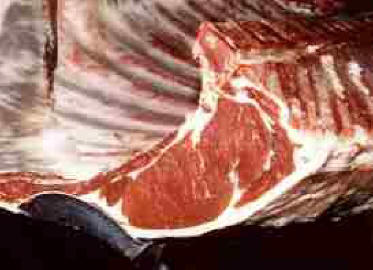
The price differential between Choice and Number One grade feeder cattle with thick body condition and Number Two grade feeders with a thin body shape is from $8 to $15 per hundred on the same weight cattle. Romagnola will help you to consistently get Choice and Number One feeders.
Packers, retailers and, most important of all, consumers are getting more and more particular in their demands for lean, tender beef, with less fat around the outside. Choice and Number One feeders are the kind that grow into finished cattle that will satisfy their demands.
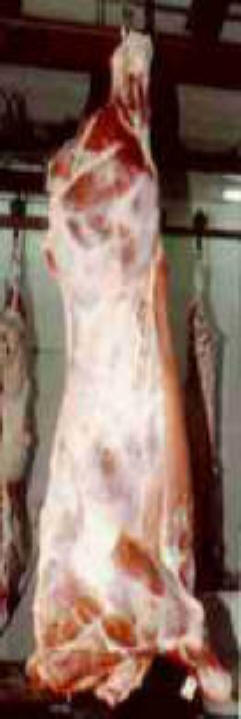
The picture below is what you would see with some other breeds. You
will not build back fat with a Romagnola bull. The Romagnola breed does
not contain the fat that is wasted as with other breeds.
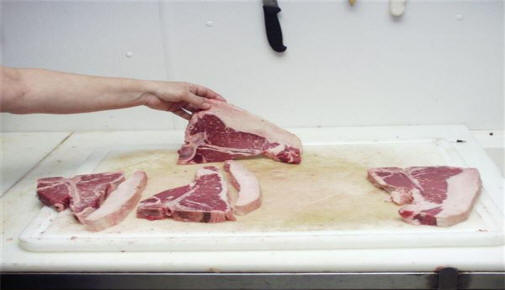
After years in the steak house business, it is very costly to absorb the
fat cost on a beef loin. The fat was only used to oil the char grille!
Producing Choice and Number One feeders out of most native cow herds requires the service of a powerful, longer, leaner, more muscular bull, a bull that can add to weaning size and weight, and a bull that can add that visible, thicker muscling order buyers are looking for - all while maintaining low birth weights. For this reason, modern, progressive producers of feeder calves are moving, more and more, to Terminal Sire breeding programs, in which all production goes to the feeder market, and the female can be used for replacement cows or go to the feeder market as well.
Of the more than 130 breeds of American beef cattle, only a very few have remained sire breeds. Only a very few have escaped the tendency of American breeders and producers to select hard for the maternal traits in an effort to produce smooth, mellow, females. In most breeds selection for these traits have succeeded dramatically, so that even many of the once big, muscular Continental breeds now fall into the category of maternal breeds. As such, they no longer have the size, scale and muscularity necessary to produce consistently heavy, long, muscular, smooth feeder cattle out of most native cow herds.
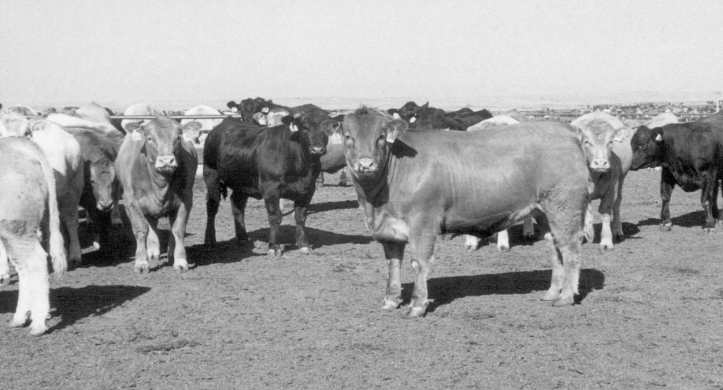
Among all the sire breeds that remain in the industry, only Romagnola offer all of the qualities needed in an ideal terminal sire.
|
| ||
|
||
|
| ||
|
| ||
  | ||
|
| ||
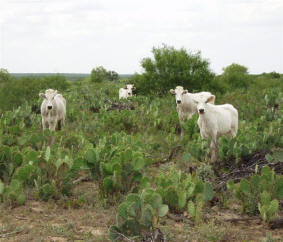
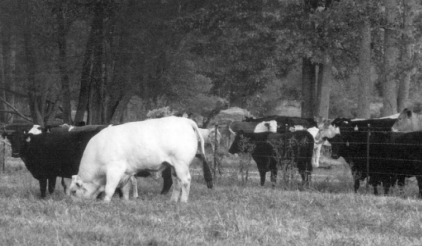 There is an underlying strain of Bos Indicus in the ancient
Romagnola proven by blood typing that allows them to function well
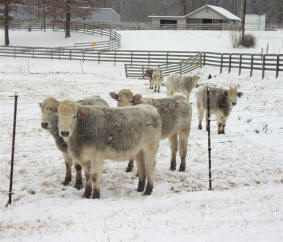
under extreme climatic conditions. Romagnola handle heat and humidity, as
well as extreme cold very well. Romagnola demonstrate a marked resistance
to external parasites. There is an underlying strain of Bos Indicus in the ancient
Romagnola proven by blood typing that allows them to function well
under extreme climatic conditions. Romagnola handle heat and humidity, as
well as extreme cold very well. Romagnola demonstrate a marked resistance
to external parasites. | ||
|
| ||
|
|
It is fact that the average terminal sire program produces more pounds in production - that means more income. It makes sense that as Romagnola become better known, producers seeking increased profits from their operations will consider the Romagnola bull.